Peach Fuzz Alternatives for PCOS Hair: Complete Guide

Updated: Sep 16
Table of Contents
Understanding PCOS Hair Growth vs. Peach Fuzz
Laser Hair Removal for PCOS Hormonal Hair
How Professional Laser Works on Hormonal Hair
At-Home IPL Devices as an Alternative
How Many Laser Sessions for PCOS Hair Removal
Dermaplaning vs. Laser for PCOS: Which Works Better
Electrolysis: The FDA-Approved Permanent Option
Managing Hair Growth Through Hormonal Regulation
Comparison of All Peach Fuzz Alternatives for PCOS
Why Professional Treatment Differs from At-Home Solutions
Last Updated: August 20, 2026
Understanding PCOS Hair Growth vs. Peach Fuzz
Peach fuzz is fine, light vellus hair that covers most of the body naturally, typically blonde or colorless and barely visible. PCOS hair growth is coarse terminal hair driven by elevated androgen levels, the male hormones that circulate in higher amounts in people with polycystic ovary syndrome.
This distinction matters because it determines which removal methods work. Vellus hair responds poorly to laser treatment since it lacks the pigment that laser targets. Terminal hair, the thick, dark hair PCOS triggers, responds dramatically to professional laser and other removal methods. PCOS hair growth is particularly challenging because its hormonal root creates persistent hair that regrows quickly. A person without PCOS might see permanent results from six laser sessions, while someone with PCOS managing active hormonal imbalance may need ongoing maintenance because new follicles keep activating.

Laser Hair Removal for PCOS Hormonal Hair
How Professional Laser Works on Hormonal Hair
Professional laser hair removal targets the melanin (pigment) in hair follicles, destroying them with concentrated light energy. For PCOS-related hair, this is highly effective because terminal hair contains the dark pigment that absorbs laser energy efficiently. The laser heats the follicle to a temperature that damages the growth center, preventing regrowth.
The challenge with PCOS is that hormonal fluctuations can activate dormant follicles. Even after successful laser sessions eliminate existing hair, new follicles may activate due to ongoing androgen levels. This doesn't mean laser fails; it means PCOS patients often need maintenance sessions that someone without the condition might not require.
Professional laser offers precision and power that at-home devices can't match. PINK MINK NYC specializes in laser hair removal tailored to individual Fitzpatrick skin types, with particular expertise in treating PCOS-related hair growth. The clinic's groundbreaking technique and specialized aftercare address the unique needs of hormonal hair, delivering results in as few as three sessions for many patients. The FDA has cleared laser hair removal for safety, though results vary based on hair color, skin tone, and hormonal status.
At-Home IPL Devices as an Alternative
Intense Pulsed Light (IPL) devices for home use offer affordability and convenience, though with trade-offs in power and consistency. The MimiSilk Peach Fuzz IPL Hair Removal Device is FDA-cleared and uses advanced cooling technology for a painless experience. It's designed for full-body treatment in approximately 10 minutes and includes 990,000+ flashes for long-term use.
For PCOS hair, at-home IPL works best on darker, coarser hair where the pigment contrast is greatest. Results take longer than professional laser, typically several months of consistent weekly use before visible reduction. Home IPL devices deliver lower energy than clinic lasers, so they work more slowly and may not eliminate hair as completely. Many people start enthusiastically and miss sessions, which derails progress.
At-home IPL costs significantly less upfront than professional laser. Expect 6-12 months of consistent use before substantial results, and plan for ongoing maintenance.
How Many Laser Sessions for PCOS Hair Removal
Most people see significant reduction after 6-8 sessions spaced 4-6 weeks apart. Hair grows in cycles, and laser only destroys follicles in the active growth phase. Typically, 20-30% of your hair is in that phase at any given time, which is why multiple sessions are necessary. With PCOS, the additional factor is hormonal activation of dormant follicles.
PINK MINK NYC reports that many patients see dramatic results in as few as three sessions, though this depends on individual hormonal status, hair density, and skin type.
Maintenance sessions are common for PCOS patients. After completing your initial series, many people return every 6-12 months for touch-ups to address newly activated follicles. This isn't a failure of the treatment; it's a realistic acknowledgment of how PCOS works.
Pro Tip Track your hormone levels alongside your laser sessions. If you're not seeing expected progress, ask your doctor about insulin resistance or androgen levels. Sometimes the limiting factor isn't the laser, it's uncontrolled hormones creating new hair faster than laser can eliminate it.
Dermaplaning vs. Laser for PCOS: Which Works Better
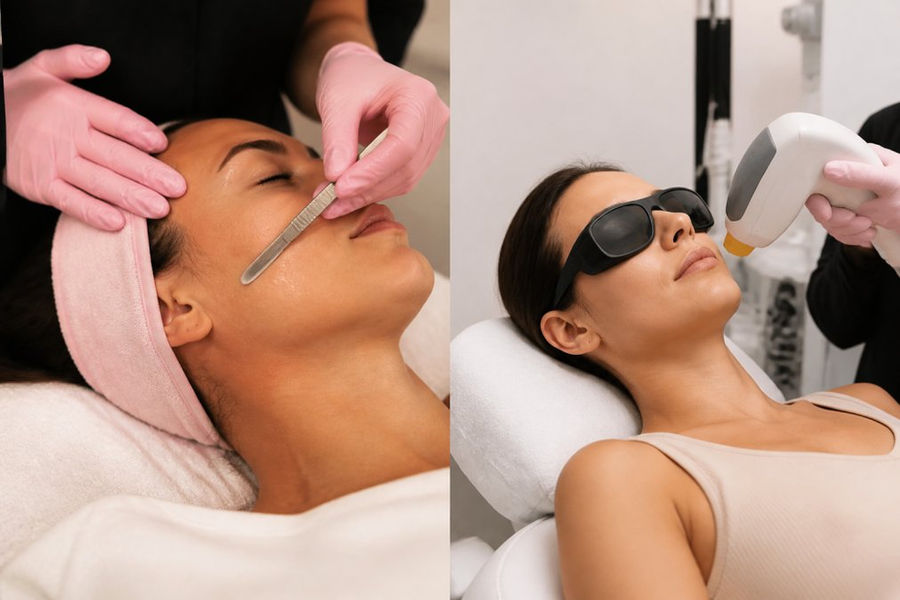
Dermaplaning is a physical exfoliation technique using a sterile blade to remove vellus hair and dead skin cells from the face. It's gentler than laser, requires no recovery time, and works on all skin types. For PCOS-related facial hair, dermaplaning addresses peach fuzz and light hair effectively.
The critical limitation: dermaplaning does not work on coarse terminal hair. If your PCOS causes thick, dark facial hair, dermaplaning removes it temporarily but doesn't prevent regrowth. Hair returns within 2-4 weeks because the follicle itself remains intact.
Laser hair removal permanently damages follicles. Coarse PCOS hair that returns after dermaplaning within weeks will stay gone for months or years after laser treatment. For many PCOS patients, the optimal approach combines both: use dermaplaning for maintenance between laser sessions or for lighter hair, and use laser for thick, dark terminal hair where you want lasting results.
Electrolysis: The FDA-Approved Permanent Option
Electrolysis is the only FDA-approved method for truly permanent hair removal. It uses a fine needle to deliver electrical current directly into individual hair follicles, destroying them permanently. Unlike laser, which targets pigment, electrolysis works on all hair colors, including light, gray, and red hair that laser struggles with.
For PCOS patients, electrolysis offers a unique advantage: it's less affected by hormonal fluctuations than laser. Since it destroys each follicle individually, hormonal activation of new follicles is the only ongoing concern. The follicles electrolysis has treated stay gone permanently.
The drawbacks are significant. Electrolysis is time-intensive; each hair takes 15-60 seconds depending on depth and thickness. Treating a full face or body takes many sessions, often 12-24 or more. Professional electrolysis pricing varies around $35-50 for 15-minute sessions. A full facial treatment might require 30-40 sessions or more, making it a long-term commitment. For PCOS patients with limited hair (specific areas like upper lip or chin), electrolysis is practical. For extensive body hair, it becomes prohibitively time-consuming.
Electrolysis works best as a complement to laser. Use laser for large areas with coarse dark hair, then use electrolysis for remaining light hairs or precise detail work.
Watch Out Electrolysis can cause temporary redness, swelling, and crusting at treated sites. For PCOS patients with inflammatory skin conditions like hidradenitis suppurativa, electrolysis may trigger flare-ups. Consult a dermatologist before starting if you have active skin inflammation.
Managing Hair Growth Through Hormonal Regulation
No hair removal method addresses the root cause of PCOS hair growth: elevated androgen levels and insulin resistance. While laser, electrolysis, and dermaplaning remove existing hair, managing your hormones prevents new hair from growing in the first place.
Spearmint tea has shown promise in research as a natural anti-androgenic approach. It contains rosmarinic acid and flavonoids that may help reduce circulating androgens. Many PCOS patients drink 2 cups daily and report improved hirsutism scores over 3-6 months.
Insulin resistance drives much of PCOS-related hair growth. Managing blood sugar through diet, exercise, and sometimes medication (like metformin) can reduce androgen production over time. Weight management, when relevant, can improve insulin sensitivity and reduce androgen levels. Even modest weight loss (5-10% of body weight) can meaningfully improve PCOS symptoms in some people.
Hormonal birth control and anti-androgen medications like spironolactone can suppress hair growth directly. If you're pursuing laser hair removal, discuss hormonal management with your doctor; the combination of medication plus laser often delivers faster, more complete results than either alone.
Key Takeaway Hair removal and hormonal management work best together. Laser eliminates existing hair; hormone management prevents new growth. Neither alone is a complete solution for PCOS.
Comparison of All Peach Fuzz Alternatives for PCOS
Method | Timeline to Results | Permanence | Best For | Maintenance |
Professional Laser | 6-8 sessions, 4-6 weeks apart | Permanent to semi-permanent | Coarse dark terminal hair | Every 6-12 months |
At-Home IPL | 6-12 months consistent use | Semi-permanent | Budget-conscious patients | Weekly or bi-weekly ongoing |
Dermaplaning | Immediate | Temporary (2-4 weeks) | Fine facial hair, exfoliation | Monthly or as needed |
Electrolysis | 12-40+ sessions | Permanent | Light/gray hair, precision areas | Minimal after completion |
Hormonal Management (Spearmint, medication) | 3-6 months | Addresses root cause | Reducing new growth | Ongoing daily/medication |
Each alternative addresses different needs. For someone with PCOS and coarse dark facial hair who wants lasting results, professional laser is the fastest path. For someone with primarily fine hair and budget constraints, at-home IPL or dermaplaning might suffice. For light hair that laser won't touch, electrolysis becomes necessary. The most effective approach for many PCOS patients combines methods: professional laser for density and speed, electrolysis for remaining light hairs, and hormonal management to prevent new growth.
Why Professional Treatment Differs from At-Home Solutions
Clinic-grade lasers deliver 2-3 times more energy than home IPL devices. This higher power destroys follicles more completely and works faster, typically 6-8 sessions versus 12+ months of home use. Professional lasers also offer wavelength options that work on different skin tones; a skilled technician adjusts settings for your specific Fitzpatrick skin type, reducing risk of burns or pigmentation changes.
Expertise matters enormously for PCOS patients. A technician trained in hormonal hair patterns knows to treat more densely, space sessions strategically, and recognize when hormonal fluctuations are interfering with results. They can also identify contraindications that require caution.
Aftercare separates professional results from mediocre ones. PINK MINK NYC uses groundbreaking aftercare techniques tailored to individual skin types and PCOS-specific needs.
The lifetime satisfaction guarantee that PINK MINK NYC offers reflects confidence in professional results. Pricing depends on quantity, dates, and delivery. For current prices or a quote, please visit PINK MINK NYC's website. For PCOS patients specifically, professional treatment accounts for hormonal complexity that at-home devices ignore. New follicle activation, variable response to treatment, and skin sensitivity all require professional judgment.
PCOS hair growth demands a treatment strategy that acknowledges both the immediate cosmetic concern and the underlying hormonal complexity. Whether you choose professional laser, electrolysis, dermaplaning, or a combination depends on your hair type, budget, timeline, and skin sensitivity. PINK MINK NYC specializes in laser hair removal tailored to hormonal hair growth with groundbreaking techniques designed for diverse skin types and PCOS-specific needs. Their lifetime satisfaction guarantee and expertise in rapid results (often in as few as three sessions) reflect the difference professional, specialized care makes. Get started with PINK MINK NYC and move toward the hair-free results you're seeking.
Frequently Asked Questions
Does peach fuzz always indicate PCOS?
No. Peach fuzz is fine, light vellus hair that most people have naturally. However, PCOS-related hair growth typically presents as thicker, darker terminal hair on the face, chin, and body due to elevated androgen levels. If you notice a sudden increase in coarse, dark facial hair, consulting a healthcare provider can help determine whether hormonal imbalance is involved. Not all unwanted facial hair signals PCOS.
Is laser hair removal safe for PCOS-related hormonal hair?
Yes, laser hair removal is generally safe for PCOS-related hair when performed by a qualified professional experienced with hormonal hair growth. However, because PCOS involves fluctuating hormone levels, new hair may continue to grow between sessions. Professional laser treatments are FDA-approved and can be customized for different skin types. Always consult with a dermatologist or certified laser specialist to discuss your specific condition and ensure the treatment is appropriate for you.
What makes professional laser hair removal more effective than at-home devices for PCOS?
Professional laser systems deliver higher energy levels and have cooling mechanisms that allow for more aggressive treatment on coarse, hormonal hair. They also offer customized settings based on your skin tone and hair type. At-home IPL devices are less powerful and work best on lighter skin with darker hair. For PCOS-related hair, which is often thick and stubborn, professional treatment typically produces faster, more visible results. However, at-home devices offer convenience and lower cost for maintenance between professional sessions.
Can I use dermaplaning if I have PCOS?
Yes, dermaplaning is safe for PCOS-related hair removal. It physically removes surface hair and dead skin cells without affecting the follicle. However, dermaplaning only addresses surface hair and does not prevent regrowth. For hormonal hair driven by PCOS, dermaplaning works best as a maintenance tool between laser or electrolysis sessions, or as a gentler alternative if your skin is too sensitive for other methods. Results are temporary, typically lasting 2-4 weeks.
BOOK NOW
This article was written using GrandRanker


Comments